ASSIST FOR VISUALLY IMPAIRED (VI) CATCH
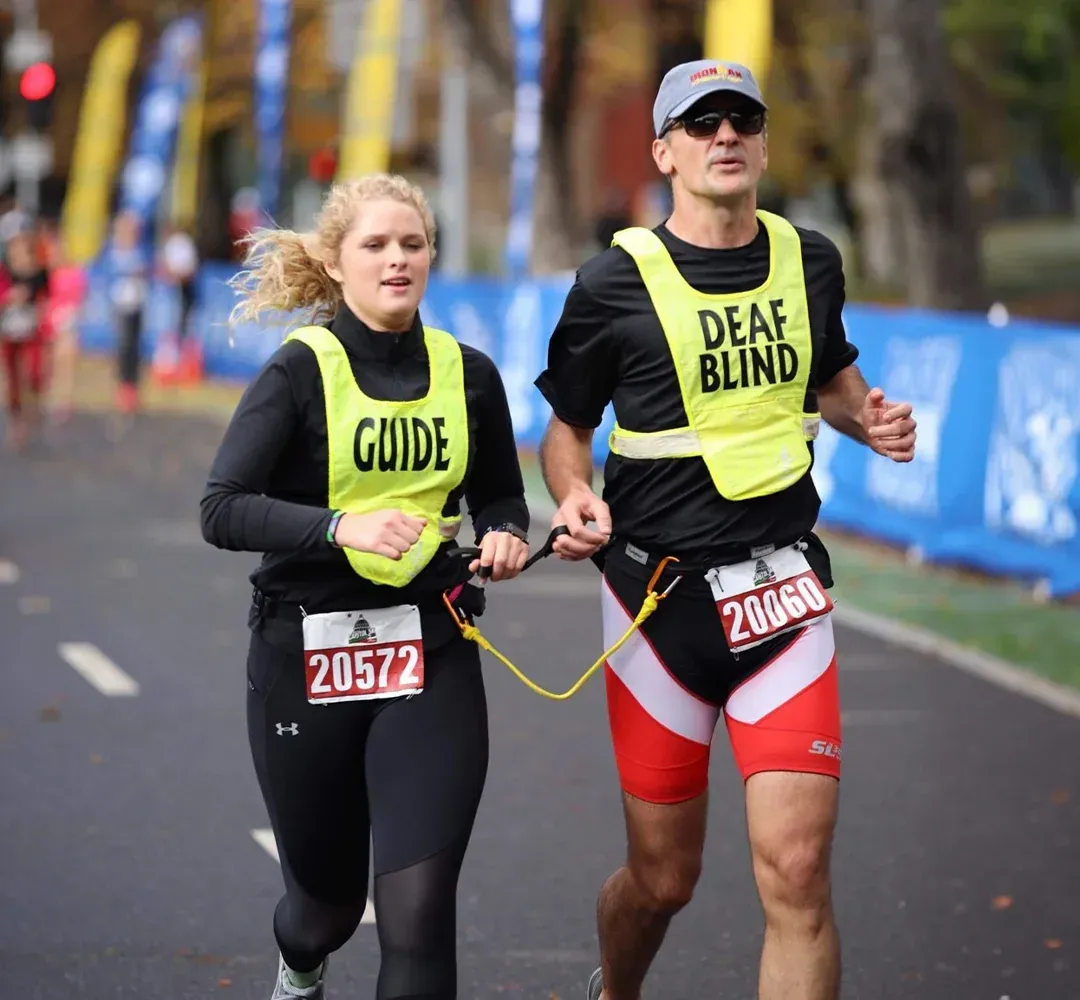
The Tether
Teammates will be connected with a Hand-Held Tether, which is a strap with a loop on both ends, approximately 18-inches long.
When in Doubt, Call it Out!
A visually impaired walker/runner cannot see, so they rely on what you tell them to understand obstacles, terrain, and the environment around them.
Even if something doesn’t present an obvious tripping hazard to a sighted person such as a small puddle, pile of leaves, mud, or gravel on a road surface, always try to alert the VI walker/runner to what is coming up if you must go through it.
Announce what is coming up:
“We’ll be running downhill for a couple hundred yards and then the road flattens out.”
“There is a cyclist approaching us. They are on the other side of the path so let’s stay where we are at.”
“There is a stoplight coming up, we are going to come to a stop at the end of the sidewalk and wait for it to turn green.”
Inform of terrain changes:
Always inform the VI athlete about transitions such as moving from pavement to cobblestone, or pavement to dirt or grass, when stepping onto a wooden bridge, cresting a hill, dips or bumps in a path, etc.
You may have to slow down for a few steps at the point of change for the VI walker/runner to adjust to the new terrain.
3-2-1 countdown:
This can be used when alerting the VI athlete to the timing of various obstacles, turns or changes in footing.
For example, “We will be stepping down a curb in 3-2-1, step down.” “There are some overhanging branches, so we’ll duck in 3-2-1 duck. All clear.” “We’ll be making a hard right turn in 3-2-1, turn.”
Be a bumper:
When guiding a visually impaired athlete, there will be physical contact. It is the responsibility of the guide to act as a “bumper” on one side from potential hazards. It’s important that the guide holds their position. When the VI walker/runner accidentally bumps into the guide, they can correct their course.
When using a hand-held tether, the guide will be the “bumper on one side and the tether provides the limit on the other side.
Run single file in tight spaces:
When moving between tight obstacles such as poles in your path, or navigating groups or cyclists, there are times you will need to run single file. First announce the upcoming movement, for example, “we have an approaching cyclist so move behind me”. The guide will initially need to speed up to get into the right position in front of the VI athlete.
If using a tether, the guide will hold their tethered hand in the middle of their back so the VI athlete can center behind the them. Since the tether is quite short, the VI athlete will be holding their arm out in front to allow for enough space to avoid tripping the guide.
Once the obstacle is clear, call out, “all clear,” and the VI athlete can once again come alongside the guide. Running/walking single file can be a challenge so is normally only done for clearing brief obstacles that cannot be negotiated in any other way.
Last minute physical corrections are OK:
If words can’t come fast enough to avoid an obstacle, it’s OK to push/yank the VI athlete out of the way. They would much rather have that then falling on their face!
Describe visual observations:
Tell the VI athlete about your visual observations of what is going on around you. A colorful sunrise or sunset, flowers in bloom, or other beautiful, odd or funny things going on around you shouldn’t be kept secret.
Practice on your own:
When out running/walking on your own, practice calling out what you would say if you were guiding. This will allow you to work on your timing of cues and begin paying attention to the world around you that normally goes unnoticed.
You can also blindfold yourself and have a friend guide you to have a better sense of what cues are helpful. If you have a willing friend who trusts you, blindfold them and take them out to practice with you. It can be equally helpful to blindfold yourself for a short practice, while being guided by a friend, so you develop a better sense of the types of cues that you would want to have.
During a race:
When guiding at races, the guide will oftentimes also give the VI athlete pacing feedback and grab the water cups from the volunteers.
ASSIST FOR IN-CHAIR CATCH

The Tether
The safety leash must be wrapped securely around the pusher’s wrist before the wheels move. If a runner trips or drops their phone, the chair cannot be allowed to roll away on its own.
Braking Hand
Racing chairs carry massive momentum. The pusher must always keep their dominant hand close to the handbrake lever—especially if the course has any downhills or sharp turns.
"Pop & Pivot:"
To turn, the runner cannot just twist the handlebars. They need to put slight downward pressure on the handlebar to lift the front wheel a fraction of an inch off the ground, then gently pivot the chair in the direction of the turn.
Run Close, Don't Lean:
Pushers instinctively want to hunch over and push the chair far out in front of themselves. Tell them to stand tall, run right up close to the back of the chair, and push from their core/hips, not their shoulders.
Call Out the Course:
Because the athlete is sitting low to the ground, they cannot see what is coming. The pusher must verbally call out bumps, cracks, turns, and crowds ("Turning right in 3, 2, 1..." or "Big bump ahead").
Check In Frequently:
On-the-fly feedback is critical. Instruct the runner to ask the athlete how the pace feels and if they feel secure in the seat after the first half-mile.